
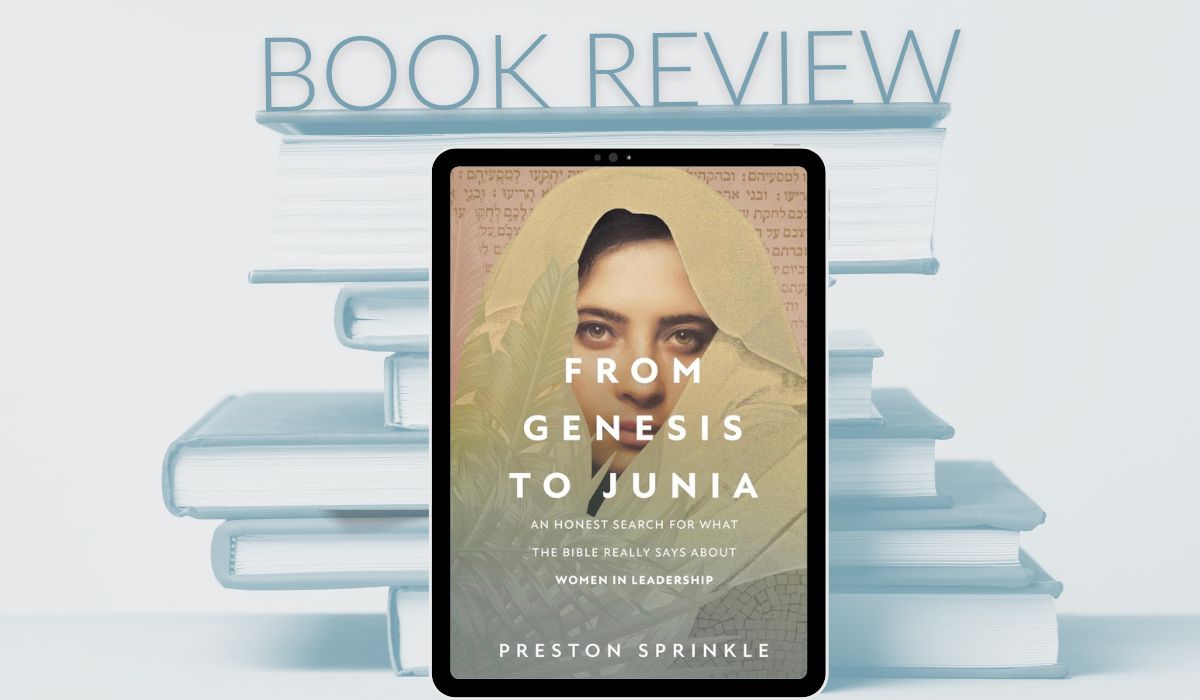
Preston Sprinkle’s new book From Genesis to Junia claims to be “an honest search for what the Bible really says about women in leadership.” I think it lives up to that subtitle.
I’ve been seeing posts for the last year or so floating around on social media, building anticipation for this book’s release, and I could never tell exactly which side of the debate the author was writing from. I now know this was very intentional on his part. And guess what. He keeps you guessing…right to the end.
The book is more of an invitation to peek over his shoulder, to come along on the twists and turns of his research journey, which is impressively thorough. There are many, many footnotes to explore, if this is something that interests you in a deeper dive.
I found I was able to get through the book’s three hundred pages pretty quickly. Being a topic I am already quite familiar with, I didn’t have to slow down in the more tedious sections. And I was motivated to keep moving to find out where he would land with each argument.
I think what makes this book different (and also very powerful) is that Sprinkle did not set out with a particular agenda in mind. His discoveries feel like they are happening in real time. Of course, every author comes to their topic with some degree of bias, but he makes it clear that he doesn’t “have external pressures — a job, a church, relationships — nudging me toward one view over another” (p. 12). He’s not putting his career in jeopardy, regardless of his conclusions. He has friends, good friends (relationships he is confident will remain intact) on either side of the debate.
As tempted as I was to flip ahead and read the final pages to satisfy my curiosity, I resisted the urge. And I was rewarded, moved to tears actually, with his concluding paragraphs. I don’t want to spoil the journey for you either, so here is just a little taste of the probing questions he explores:
What does it mean to be a leader according to Jesus? (p. 85)
It’s important to recognize that biblical authors were not necessarily tailoring their books to answer our burning questions in the present-day Church. We need to define our terms clearly. I like how Sprinkle says, “In the Gospels, women don’t wield modern CEO-like authority. But they are the only disciples who act as servants — the key leadership trait of Christianity” (p. 87).
Who is Paul trying to keep out of being an overseer with the phrase ‘one woman-man’? (p. 279)
Good question. Is he trying to disqualify polygamists, divorcées who have remarried, singles? What’s his intention in using that phrase? Is the focus on gender, marital status, faithfulness?
Though not directly related to women in leadership, I enjoyed the author’s discussion of one of the most debated words in all of the New Testament — the Greek word for “head” (kephalē) in Ephesians 5. Complementarians hold to a connotation of “authority”, while egalitarians, by and large, would say it refers to “source”, like the headwaters of a river, for example.
Spoiler alert! Sprinkle leans toward “authority” for kephalē, but goes on to quote Michelle Lee-Barnewall: “When Paul asks husbands, and not wives, to love and sacrifice, this reversal would be shocking in light of traditional status conventions because he tells the most honored part, the head, to perform the duties of the less honored member…It is the unexpectedness of this reversal that ultimately gives the metaphor its power in this passage” (p. 181-182). Sprinkle explains:
It’s as if Paul meets his audience where they’re at in [Ephesians] 5:22-24 and then takes them on a journey toward mutuality and interdependence in verses 25-32 — something he’s already hinted at in verse 21 (p. 190).
Interesting. Can kephalē be interpreted as “authority” and still point toward mutuality?
One thing is for sure, this book is rooted in exegetical precision, not emotional appeals. Despite its plethora of footnotes, it is very accessible, an easy read for anyone interested in the topic of women in leadership. I love that he had the manuscript torn to shreds by esteemed scholars on all sides. The final draft preserves that sense of respectful dialogue. There is no whiff of condescension or name-calling.
The fact that I had trouble discerning if or where he would land shows me that no matter which side of this debate we identify with, we could have a lot more in common than we might initially assume. I am incredibly hopeful that maybe, just maybe, this will be a book to inspire more dialogue and deeper understanding of this issue, for those who disagree with one another or with the author’s conclusions.
Please note: I received an advanced reader copy from the publisher for review, but all opinions are my own.
Pre-order your copy of From Genesis to Junia on Amazon here.
If you’d like to connect on Goodreads, you can find me here.