
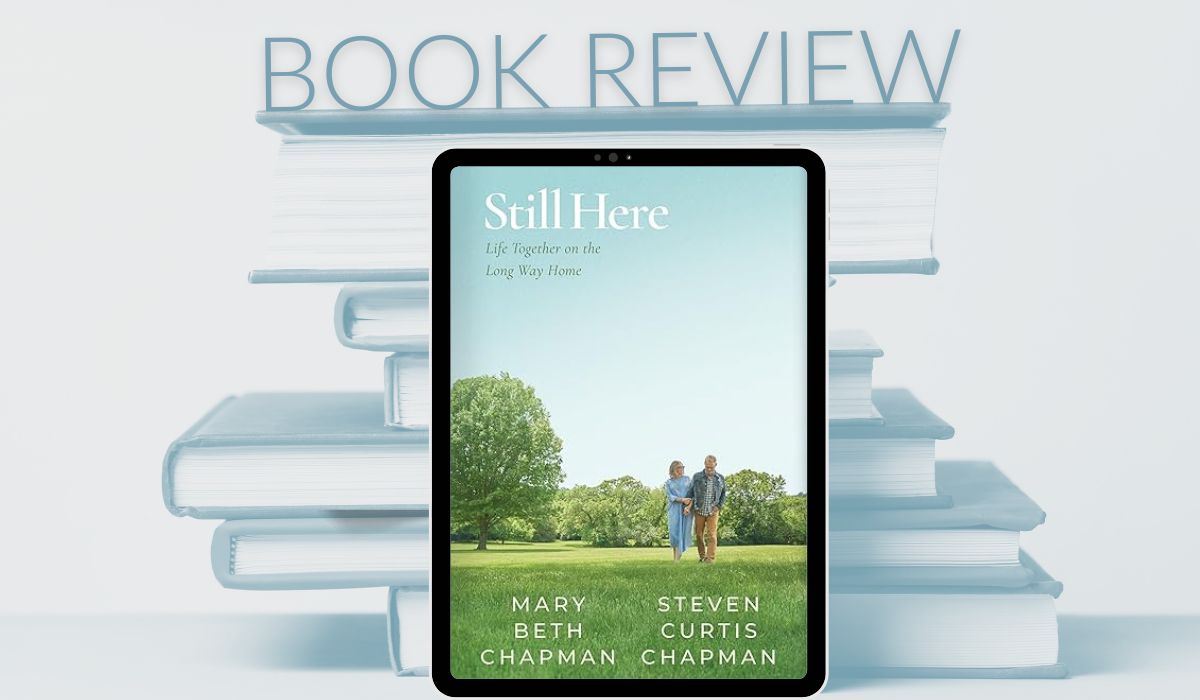
Still Here: Life Together on the Long Way Home by Mary Beth and Steven Curtis Chapman, due to release next month, tells the story of their rather tumultuous marriage of forty plus years. The book reads like a friendly letter and has the feel of an intimate conversation over coffee. This heartfelt, behind-the-scenes peek will be something avid fans will treasure…from the “T” to the “R” to the “E” to the “A” to the “S” to the “U” to the “R” to the “E”. (If you know, you know. And, yes, I can still recite that entire rap sequence from memory just as well as I could in high school!)
As I made my way through this book, I found myself wishing the authors had anchored it more concretely in story. The lessons learned are shared as broad generalizations without many real life illustrations. That is especially problematic when tackling a topic like marriage, especially when they allude many times to how volatile their relationship has been and how much shame they carry because of it. Without explaining what that practically looks like, it leaves room for a reader to mistake an abusive marriage for one that is simply likewise “volatile.”
The one concrete issue they do circle back to numerous times is the challenge they’ve faced in aligning their expectations for their calendar. So when general statements are made about marriage being hard, it needs to be acknowledged that there is a “hard” beyond the logistics of family scheduling that many marriages face, a “hard” that might not be well suited to the advice in these pages.
The American Association for Marriage and Family Therapy reports physical abuse in nearly 20% of intimate partnerships. If emotional abuse is included, that number climbs much higher. Any book on the topic of marriage needs to consider this prevalent reality.
In a chapter about giving up our desire to always have things our own way, they write:
What if I just laid it all down? What if I denied myself what I want? And what if, the next time I find myself feeling this way, I laid it down again? What if it had to be me every time? Would I be willing to do that?
I would contend that’s not a healthy choice for the same spouse to make every time, nor is it God’s intention for a marriage relationship to be so one-sided.
Thankfully, they do include the following disclaimer:
…we are not talking about succumbing to abusive treatment from a dominant spouse. We are not talking about allowing yourself to cower beneath your human worth because of a toxic imbalance of power in your home.
But there is no further mention of what to do if this is the reality in your home. What about the advice in subsequent chapters? In what situations does it apply?
For someone in an unsafe marriage, the conclusions drawn in this book could be dangerous. On the other hand, for someone in a highly compatible marriage, it will not likely be very relatable. I would recommend this read to those in overall healthy yet mismatched marriages. It’s obvious the Chapman’s relationship is one of mutual love and admiration, where both of them have put a great deal of effort into making their highly incompatible marriage last. Readers will find lots of encouragement in these pages to continue working through personality differences together.
I suppose it’s not surprising, being written by such a clashing couple, that the book casts marriage in a rather adversarial light instead of framing it in terms of teamwork. They see one another as God’s refining tool and describe marriage as “the toughest sanctification practice field of all.” They even go so far as to say God tricks us into this process.
…how cosmically ingenious — the fact that God’s chosen method for leading us out onto the toughest sanctification practice field of all is marriage. He lets us choose it ourselves! He makes us unwittingly want it, falling crazy in love…We willingly walk the aisle, choosing to share our innermost being with this man or this woman for a lifetime, not realizing the package deal we’ve just accepted. Now He’s got us where He wants us.
I find this portrayal disturbing and can imagine such a description of the Father would be damaging to someone who has suffered real harm from their spouse.
Equally problematic is the way marriage is idolized and overly spiritualized throughout the book. It gets elevated in a confusing way, with parallels drawn even to our eternal salvation.
…your marriage is not just your marriage. It’s got the everlasting gospel written all over it. And so it’s infused with God’s promises, the same way the gospel is, the same way your hopes of heaven are.
Ephesians 5:32 is partially quoted as follows: “‘This mystery is profound,’ the Bible says, the mystery of marriage.” Except that the latter half of that verse, which is left out, says the profound mystery Paul is actually referring to is “Christ and the church,” not marriage.
The authors reverse the illustration, using marriage as a picture of Christ’s love instead of using Christ’s love as an illustration for marriage. That may just sound like semantics, but I believe it is important, especially considering they go on to suggest if you are struggling to really believe Jesus loves you and died for you, you should think about how your spouse would die for you. They say, “You can see it now because marriage shows it to you.”
But Ephesians 5 teaches us how to love our spouse because Jesus shows it to us! If we are to understand the ins and outs of the gospel in light of marriage (rather than the other way around), I think many of us would be in trouble.
This matters, because when we reverse the illustration, we (however unintentionally) idolize marriage in a way we should not. When we over-spiritualize the institution of marriage, it raises the stakes so high that marriage becomes more important than the wellbeing of the persons who inhabit it.
The Chapmans boil marriage down to making one simple decision, the decision to “still be here.” This determination is presented as the key to marital longevity, and longevity is presented as the ultimate goal. Again, I believe the book unwittingly turns our focus in the wrong direction. The real goal of any Christian marriage should be to grow in Christlikeness together. That’s where we should be channeling our attention and efforts. Staying together is the byproduct of this aim.
If longevity in and of itself becomes the target, we run the risk of staying stuck in all sorts of unhealthy patterns in our relationship. We might make it to the finish line. But in the process, we might also miss out on the joys and blessings of developing a healthier, happier marriage along the way.
Admirably, the authors’ one simple decision to stay the course has been a mutual one. They have travelled long together in the same direction, despite their mismatched personalities. Theirs has been a hard but rewarding journey, and I admire their bravery in sharing what they have learned. Writing a memoir of any kind is not for the faint of heart, and you can sense their nervousness in putting pen to paper on the subject of their marriage.
Still Here is an easy read, and fans (like me) will also enjoy the song lyrics peppered throughout its pages. These musical snippets stirred many memories of when those songs ministered to me at certain points along my own life journey, enhancing the conversational tone of the book.
In reaching for this new release, especially if your marriage is in trouble, please remember to read it as a memoir. For marriage advice, seek professional help from a licensed counsellor, just like the authors so transparently share that they have many, many times over the years.
Please note: I received an advanced reader copy from the publisher for review, but all opinions are my own.
Pre-order your copy of Still Here on Amazon here.
If you’d like to connect on Goodreads, you can find me here.